How Early Should You Start Looking for an NP Preceptor?

Finding an NP preceptor is one of those tasks that can look simple on a semester calendar but become more involved once you start working through specialty needs, schedules, school requirements, and clinical-site details.
If your rotation is still months away, it may be tempting to wait. In most cases, giving yourself more lead time makes the process easier to manage.
Start looking as early as you reasonably can. For many NP students, beginning around six months before the rotation is a useful planning benchmark, but it is not a universal deadline.
Your specialty, location, rotation dates, program requirements, and current preceptor availability can all affect how early you should begin. Your school’s own deadlines and approval process should guide your final timeline.
Quick Answer
Start looking for an NP preceptor as early as you reasonably can. For many students, beginning around six months before the rotation provides useful planning time, but there is no universal deadline. Specialty, location, school requirements, rotation dates, and preceptor availability can all change how early you should begin.
In This Section
- Quick Answer: Start Earlier Than the Deadline
- Why Finding an NP Preceptor Can Take Time
- A Practical NP Preceptor Search Timeline
- What Can Change How Early You Need to Start?
- What Should You Prepare Before You Start Looking?
- What If Your Rotation Is Coming Up Soon?
- How Clinical Preceptor Rescue Can Help
- Frequently Asked Questions
- Resources
- Ready to Start Your Preceptor Search?
Quick Answer: Start Earlier Than the Deadline
Your school’s deadline and the date you should begin searching are not the same thing. A deadline tells you when paperwork or approval may be due. Your search needs to start early enough to leave room for outreach, follow-up, schedule coordination, school review, and changes that may come up along the way.
Around six months before your rotation is a practical planning point for many students. Some can work with a shorter timeline. Others may benefit from starting earlier, especially when they have a narrow geographic area, a highly specific schedule, a specialty requirement, or a program with a detailed approval process.
The goal is not to make the process feel urgent before it needs to be. It is to give yourself enough time to make thoughtful decisions instead of having every step happen at once.
Why Finding an NP Preceptor Can Take Time
A preceptor search involves more than identifying a clinician who is willing to teach. The placement also needs to make sense for your rotation requirements, schedule, location, and academic program.
You may need time to confirm what type of rotation you need, identify potential clinicians, send inquiries, wait for responses, compare schedules, and complete your school’s approval steps. Some clinical sites also have their own onboarding or documentation requirements.
Availability can change, too. A clinician who is open to students may already have commitments during your rotation dates, or a schedule that works in one semester may not work in another. Starting earlier gives you more room to adjust without turning every change into a last-minute problem.
A Practical NP Preceptor Search Timeline
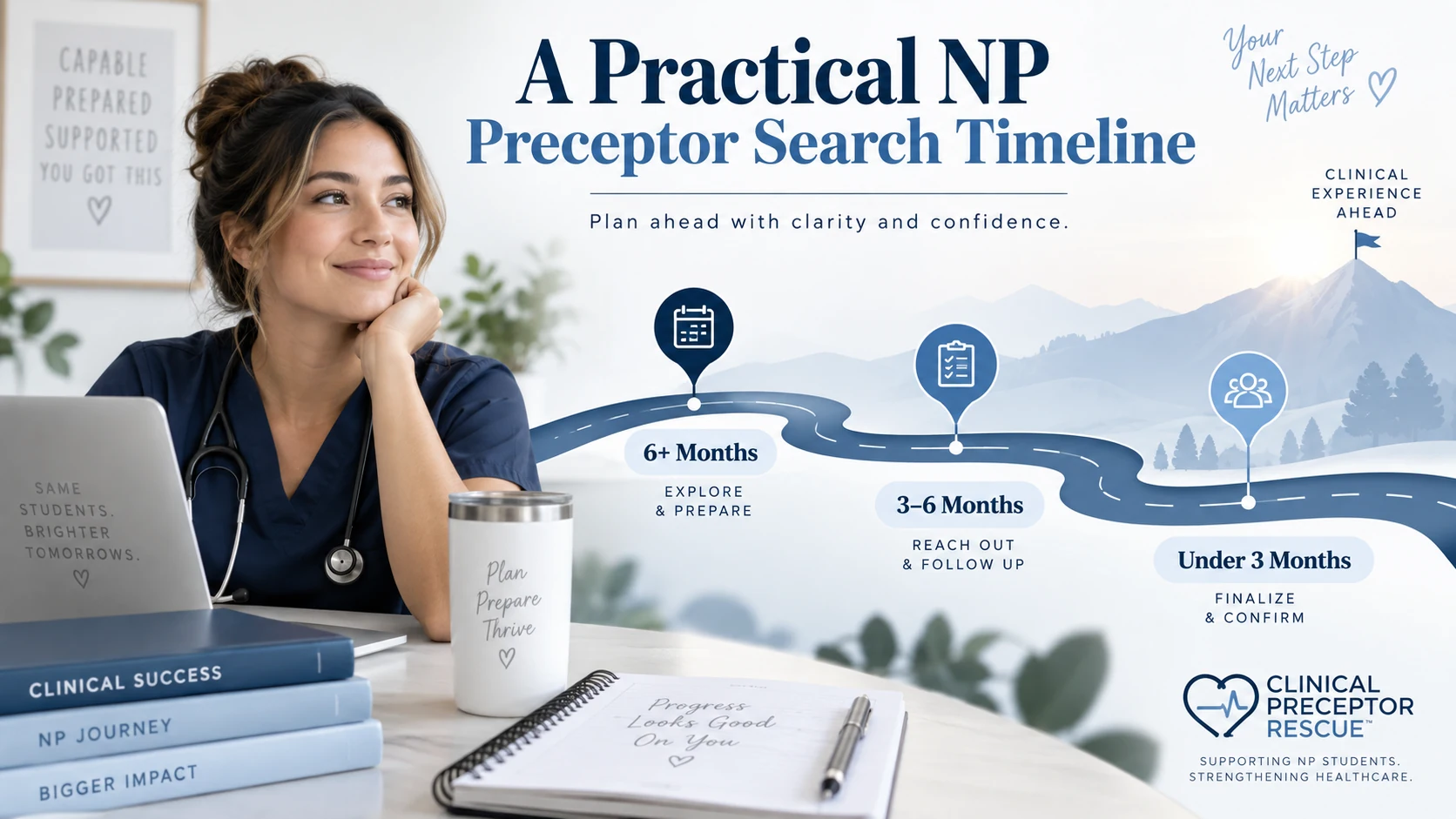
Use the timeline below as a planning framework rather than a fixed rule. Your program may require you to work earlier, or may handle parts of the process differently.
6+ MONTHS BEFORE YOUR ROTATION
Build Your Plan
Start by confirming the basics: your rotation type, required clinical hours, expected dates, school deadlines, preferred location, and any schedule limits. Review your program’s clinical handbook or placement instructions so you understand what your school expects from both the preceptor and the clinical site.
This is also a good time to begin outreach or explore matching support if you know you will need help. The earlier you understand your requirements, the easier it is to explain exactly what you are looking for.
3–6 MONTHS BEFORE YOUR ROTATION
Keep the Search Moving
If you have already started contacting potential preceptors, keep your outreach organized and follow up professionally. If your original search area is very narrow, consider whether you have reasonable flexibility in distance, days, or schedule, without stepping outside your program’s requirements.
Keep school documents and deadlines in one place. If a possible preceptor becomes available, you want to be ready to move into your program’s review process rather than spending days figuring out what information is needed.
LESS THAN 3 MONTHS BEFORE YOUR ROTATION
Focus on the Highest-Priority Steps
A shorter timeline does not mean you should assume the search will fail. It does mean you should focus on the details you can control. Confirm your school’s requirements, organize your rotation information, respond quickly to requests, and communicate with your program if you have questions about approval or deadlines.
If your own outreach is not producing workable options, this can also be a reasonable time to consider professional preceptor matching support. A service cannot control school approval or guarantee a particular timeline, but additional search support may help you widen the process while you continue managing your academic requirements.
What Can Change How Early You Need to Start?
Your Clinical Specialty
Your rotation type shapes the pool of clinicians who may be appropriate for your needs. Family practice, pediatrics, women’s health, psychiatry, acute care, and other rotations can involve different practice settings and scheduling realities. Rather than assuming one specialty is always “harder,” plan around the actual requirements your program gives you.
Your Location and Travel Flexibility
A very small search radius can limit the number of possible clinical sites. If your program allows it, deciding in advance how far you can reasonably travel can make your search more focused. Clinical Preceptor Rescue supports students nationwide, but availability still depends on the details of each individual request.
Your Program’s Approval Process
Every school or program can have its own process for reviewing preceptors and clinical sites. That may include forms, credentials, affiliation requirements, onboarding, or other documentation. Your program ultimately determines whether a preceptor or site meets its standards, so build its review timeline into your plan.
See what schools may require to approve a clinical preceptor before you submit.
Rotation Dates, Required Hours, and Schedule
Clear dates and hour requirements make it easier to determine whether a potential preceptor’s schedule can realistically support your rotation. If your program allows some flexibility, knowing where you can adjust, and where you cannot, can save time during the search.
Current Preceptor Availability
Preceptors are working clinicians with patient-care responsibilities, practice schedules, and other commitments. Even a clinician who enjoys teaching may not be available for every term. Starting ahead gives you time to explore alternatives if schedules do not line up.
What Should You Prepare Before You Start Looking?
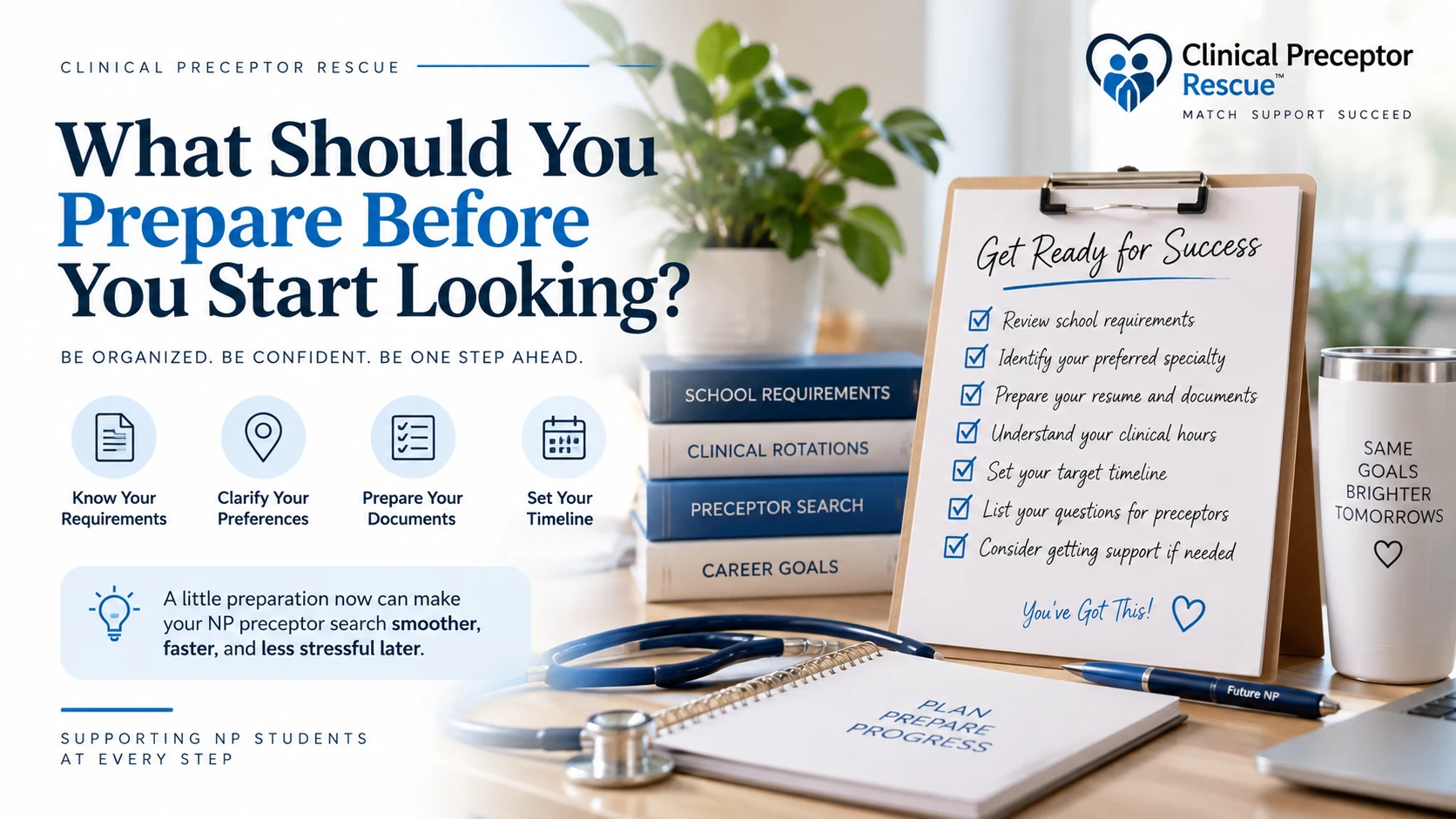
You do not need to have every possible detail memorized before you begin, but having your core rotation information ready can make outreach and matching conversations much more productive.
For a more detailed checklist, see what information to prepare before requesting a preceptor match.
Before you start, try to have the following information organized:
- Rotation specialty or clinical focus
- Number of clinical hours required
- Expected rotation start and end dates
- Your school’s submission or approval deadline
- Preferred city, ZIP code, or travel radius
- Weekly schedule or days you are available
- Program-specific requirements you already know about
- Your current resume or CV, if requested
- Any clinical-placement forms your school has already provided
If something is still unclear, check with your program before making assumptions. A few minutes spent confirming a requirement can prevent unnecessary back-and-forth later.
What If Your Rotation Is Coming Up Soon?
If your start date is closer than you would like, focus on what you can do now. First, confirm your exact specialty, hours, dates, and school deadline. Next, make sure you understand what your program must approve and what information it needs from a potential preceptor or site.
Then look at where you have realistic flexibility. Can you travel farther? Are there additional days of the week you could make available? Can your program clarify whether more than one type of practice setting would meet the rotation requirement? Those questions can help you define a more workable search without lowering academic standards.
If you need additional support, you can also start your preceptor search with Clinical Preceptor Rescue. The important thing is to provide accurate details so the team can understand your needs and discuss available options with you.
How Clinical Preceptor Rescue Can Help
Clinical Preceptor Rescue works with NP students across the United States who need help connecting with clinical preceptors. Getting started begins with the Student Interest Form, where you submit your information. From there, you can schedule a quick call with the team to discuss your clinical needs and rotation details.
The service supports rotations across primary care, family practice, pediatrics, women’s health, OB/GYN, geriatrics, urgent care, acute care, psychiatry, and psychotherapy. Because every request is different, the best starting point is to share your specialty, preferred location, required hours, rotation timing, and any program requirements you already know.
If you are months ahead, that information can help you plan proactively. If your deadline is closer, it gives the team a clearer picture of what needs attention first. Either way, the goal is to make the next step more organized and less overwhelming.
Frequently Asked Questions
For broader questions about pricing, locations, specialties, and the matching process, visit our preceptor matching FAQs.
How early should I start looking for an NP preceptor?
Start as early as you reasonably can. Around six months before your rotation is a useful planning benchmark for many students, but your ideal timeline depends on your specialty, location, schedule, program requirements, and current preceptor availability. Always follow your school’s own deadlines and instructions.
Is six months always enough time to find a preceptor?
No. Six months is a planning benchmark, not a guarantee. Some searches may move faster, while others may require more lead time because of location, specialty, scheduling, or school approval requirements.
Can I start searching before I know every detail of my rotation?
You can begin planning early, but try to confirm the details that directly affect the match: specialty, clinical hours, rotation dates, school deadline, location, and any program-specific requirements. The more accurate your information is, the more focused your search can be.
Does my school have to approve my preceptor or clinical site?
Your school or academic program determines its own approval requirements. A potential preceptor or clinical site may still need to meet your program’s standards and complete required documentation before the placement is finalized.
What should I do if my rotation starts in only a few weeks?
Confirm your requirements immediately, organize your documents, communicate with your program, and be realistic about any location or schedule flexibility you may have. If your independent search is not producing options, you can also ask Clinical Preceptor Rescue about matching support. Availability and approval still depend on the specifics of your request.
Resources
- American Association of Colleges of Nursing (AACN) — Curriculum Guidelines and Standards for Quality Nurse Practitioner Education
- American Association of Nurse Practitioners (AANP) — Nurse Practitioner Preceptor Knowledge Center
- Your university or NP program’s current clinical handbook, placement deadlines, and approval requirements
Ready to Start Your Preceptor Search?
If you know your specialty, preferred location, clinical-hour requirements, and general timeline, you can take the next step by completing the Student Interest Form. Our team can review your needs and discuss available options with you.
