What Information Do You Need Before Requesting a Preceptor Match?
You may know that you need help finding an NP preceptor before you know exactly what information to gather. That is normal. A productive preceptor-matching conversation starts with a clear picture of your rotation, not a perfectly completed file of every possible document.
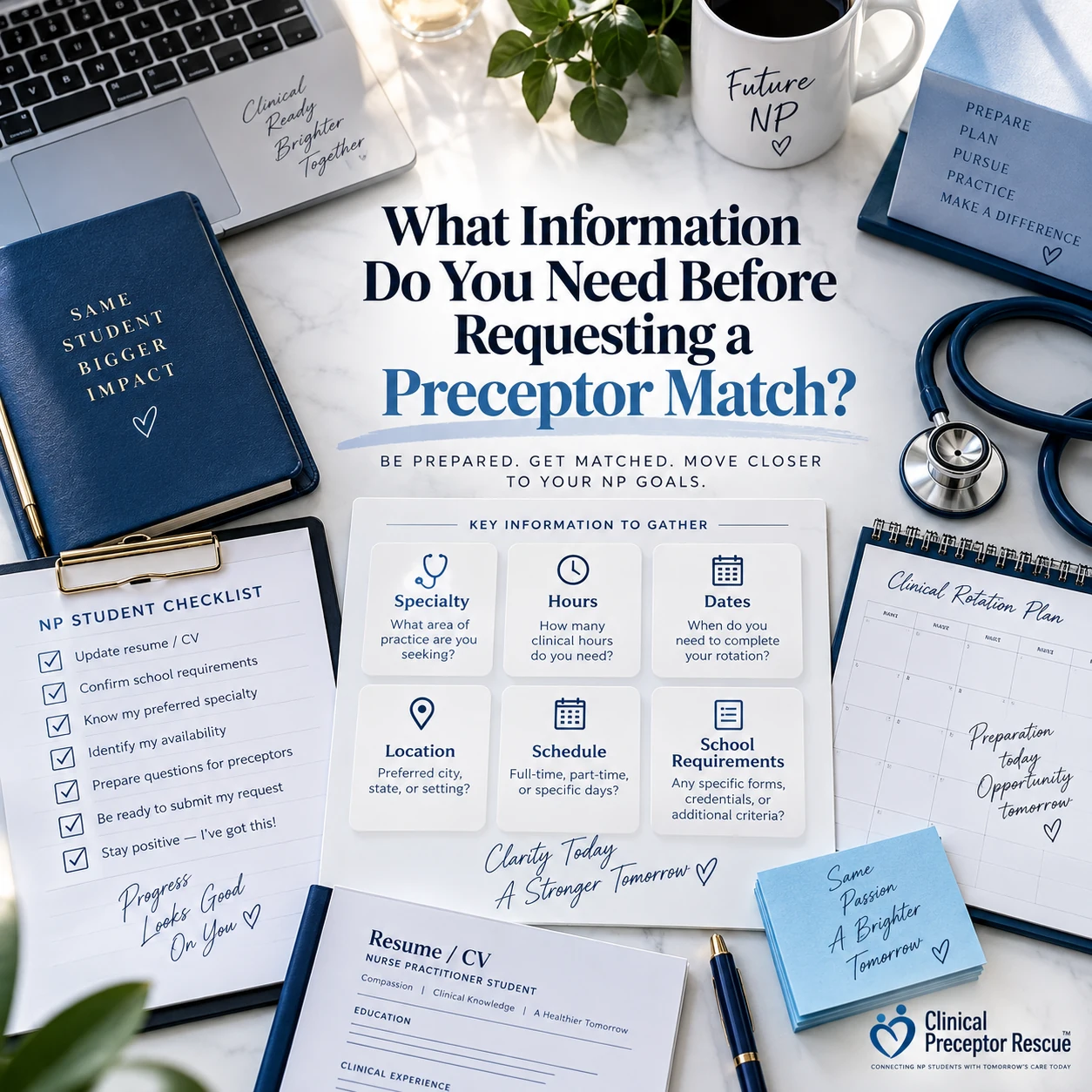
Before requesting a preceptor match, have the basics of your clinical rotation ready: your specialty, required hours, expected dates, preferred location, school deadline, schedule availability, and any program-specific requirements you already know. You do not need every detail to be perfect, but accurate information helps make the search more focused.
Quick Answer
Prepare the essentials first: rotation type, clinical hours, expected dates, location, schedule, school deadline, and known program requirements. Keep your resume or CV and school forms available if they are requested. If something is unclear, confirm it with your program rather than guessing.
In This Section
- What Information Should You Have Ready Before Requesting a Match?
- Your Clinical Specialty or Rotation Type
- Required Clinical Hours and Rotation Dates
- Preferred Location and Travel Flexibility
- Your Schedule and Availability
- Your School or Program Requirements
- Paperwork, Resume, and Supporting Documents
- What If You Do Not Know Every Detail Yet?
- How Clinical Preceptor Rescue Uses Your Information
- Frequently Asked Questions
- Resources
- Ready to Request a Preceptor Match?
What Information Should You Have Ready Before Requesting a Match?
Think of this as a readiness checklist, not a rigid intake form. The goal is to make sure you can clearly explain what kind of clinical rotation you need and what limitations or requirements may affect the search.
Before reaching out for matching help, try to organize the following:
Clinical specialty or rotation type
Required number of clinical hours
Expected rotation start and end dates
Your school’s submission or approval deadline
Preferred city, state, ZIP code, or reasonable travel radius
Days or times you are generally available
School or program name
Known preceptor, patient-population, or clinical-site requirements
A current resume or CV, if requested
Any school forms or placement documents already available
You may not need to submit every item at the first step. Having the information organized simply makes it easier to explain your needs and respond when additional details are requested.
Your Clinical Specialty or Rotation Type
Start with the type of clinical experience your program requires. Your specialty helps define what kind of preceptor and practice setting may be appropriate for the rotation.
Clinical Preceptor Rescue currently supports students seeking rotations in areas such as primary care, family practice, pediatrics, women’s health, OB/GYN, geriatrics, urgent care, acute care, psychiatry, and psychotherapy. Your own program requirements should determine how you describe the rotation you need.
If your school uses a specific course title or patient-population requirement, keep that wording handy. It can be more useful than relying on a broad label that may mean different things across programs.
Required Clinical Hours and Rotation Dates
Know how many clinical hours you need and the expected date range for the rotation whenever possible. These details help clarify whether a potential schedule could realistically fit your academic requirements.
For example, a student needing 120 hours over one term has a different scheduling picture from a student needing a longer rotation with more total hours. Exact dates also matter because preceptors are working clinicians whose availability can change from one term to the next.
If you are still several months away from your rotation, our guide on when to start your preceptor search can help you think through the timing before you request a match.
Preferred Location and Travel Flexibility

Be specific about where you would prefer to complete your rotation, but also think about how flexible you can realistically be. A city, ZIP code, county, or travel radius can give a clearer picture than simply naming a state.
If your program allows nearby locations, decide how far you can reasonably travel. You do not need to promise flexibility you do not have. It is more helpful to be accurate about your limits than to agree to an area that would not work with your schedule or responsibilities.
Clinical Preceptor Rescue works with students nationwide, but matching options still depend on the details of each request and current preceptor availability.
Your Schedule and Availability
Your weekly availability can be just as important as your location. Think about work schedules, family responsibilities, required class times, and any days that are truly unavailable.
Separate your fixed constraints from your preferences. If you cannot attend clinical on Tuesdays, say so. If you simply prefer Fridays but could adjust, that is a useful context too. Clear information helps avoid spending time on options that cannot fit your actual schedule.
Your School or Program Requirements
This is one of the most important parts of your preparation. Your school or academic program determines its own standards for clinical placements, preceptors, and sites. Those requirements can affect which opportunities are appropriate for your rotation.
Useful details may include required preceptor credentials, patient population, specialty focus, practice setting, paperwork deadlines, affiliation requirements, onboarding steps, or other criteria your program has already provided.
If you are unsure about a requirement, contact your program before assuming what will be accepted. National NP education guidance places responsibility on programs and faculty to evaluate clinical learning experiences and preceptors, so school-specific approval remains an important part of the process.
For more detail, see what your school may need to approve a clinical preceptor.
Paperwork, Resume, and Supporting Documents
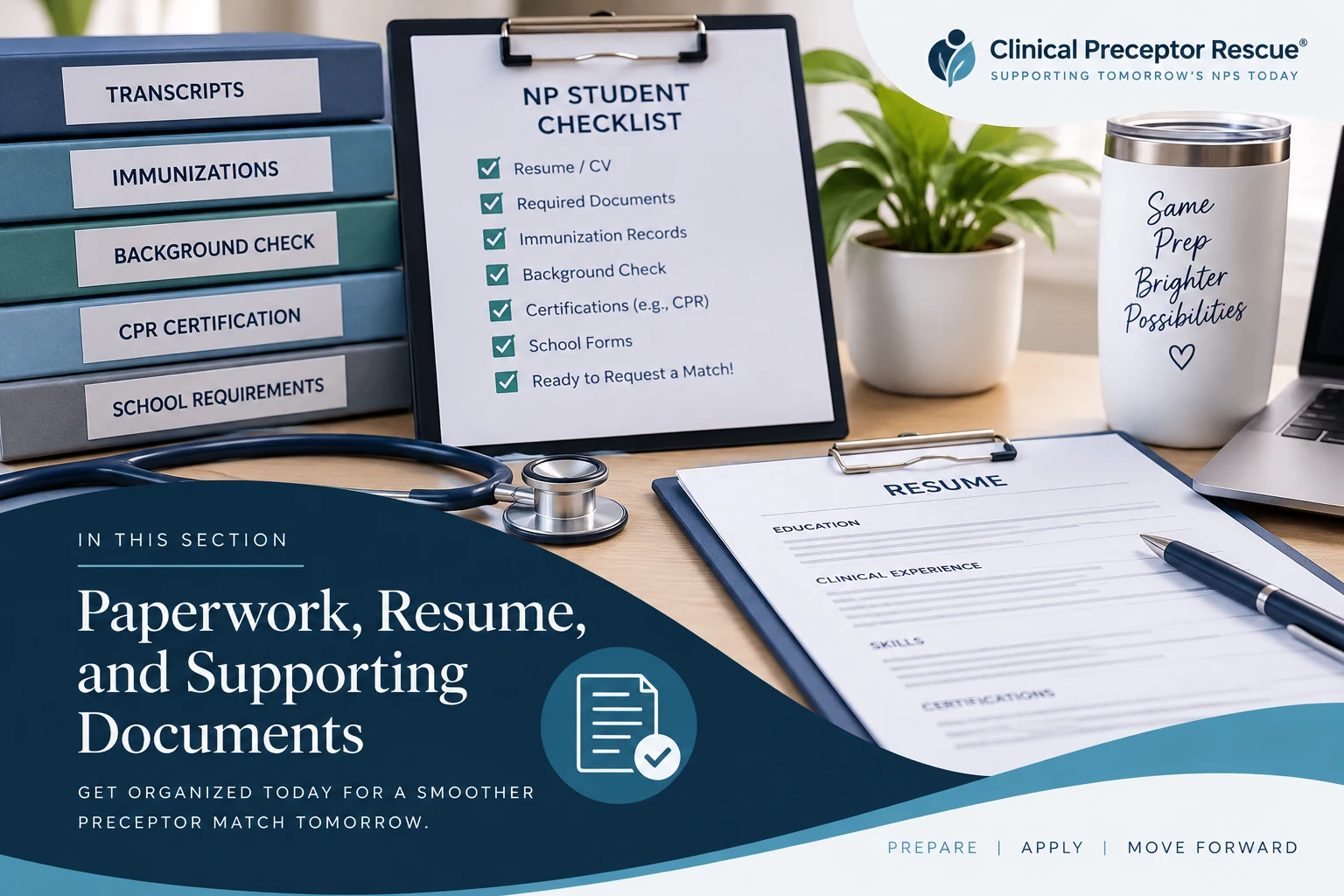
You do not necessarily need a complete paperwork package before you begin asking for help, but it is useful to know what documents you already have and what your school may request later.
Keep a current resume or CV available if it is requested. You may also want to organize any clinical-placement forms, preceptor information sheets, site requirements, or program instructions your school has provided.
Treat these documents as supporting materials, not proof that a match is finalized. Your school may still need to review a potential preceptor or clinical site before the placement can move forward.
What If You Do Not Know Every Detail Yet?
You can still start getting organized. Make two short lists: what you already know and what you still need to confirm. Then contact your program about the missing items that could affect a placement decision.
For example, you may know your specialty and required hours but still be waiting for exact course dates. Or you may know your dates but not whether your program accepts a certain practice setting. Identifying the gap is more useful than guessing.
Write down your open questions before a matching call. That makes it easier to distinguish what the matching team can discuss from what only your school can answer.
How Clinical Preceptor Rescue Uses Your Information
Clinical Preceptor Rescue’s public student process begins with the Student Interest Form. After you submit your information, you can schedule a quick call with the team to discuss your clinical needs and rotation details.
Clear information helps the team understand what you are looking for: the type of rotation, when it needs to happen, where you can travel, and what program requirements may affect the search.
If you are ready to request help finding a preceptor, you can also review the Find a Preceptor page for the current next steps.
For a broader overview of the service, visit Clinical Preceptor Rescue’s preceptor matching service information on the homepage.
Providing details does not guarantee a particular match, location, timeline, or school approval. Each request depends on the student’s requirements, current availability, and the academic program’s own standards.
Frequently Asked Questions
For additional questions about pricing, specialties, locations, and the matching process, visit our preceptor matching FAQs.
Do I need to know my exact rotation dates before requesting help?
Exact dates are helpful because they make scheduling more specific, but you can begin organizing your search before every detail is final. If your dates are still pending, know the expected term or general window and confirm the final dates with your program as soon as they are available.
What if my school has special preceptor requirements?
Write them down and share the requirements you already know. Your school or program determines whether a preceptor and clinical site meet its standards, so confirm any unclear criteria directly with your program.
Should I have my resume or CV ready?
It is useful to keep a current resume or CV available in case it is requested during the matching or placement process. However, do not assume that every student must submit the same documents at the same stage unless CPR or your school specifically asks for them.
How specific should I be about location?
Be as practical as possible. A preferred city, ZIP code, or travel radius is more useful than a very broad location. If you can travel to nearby areas, say how far. If you have firm limits, make those clear too.
Does submitting my information guarantee a match or school approval?
No. Submitting your information helps define your search needs, but availability can vary and your academic program controls its own approval requirements. A matching request should be treated as the start of the process, not a guarantee of a particular outcome.
Resources
- American Association of Colleges of Nursing (AACN) — APRN Clinical Preceptor Guide
- AACN — Standards for Quality Nurse Practitioner Education / Curriculum Guidelines
- Your university or NP program’s current clinical handbook, placement deadlines, and approval requirements
Ready to Request a Preceptor Match?
If you know your specialty, clinical hours, expected dates, preferred location, and the school requirements you already have, you are ready to take the next step. Complete the Student Interest Form and schedule a quick call with our team to discuss your rotation needs.
