What Does Your School Need to Approve a Clinical Preceptor?
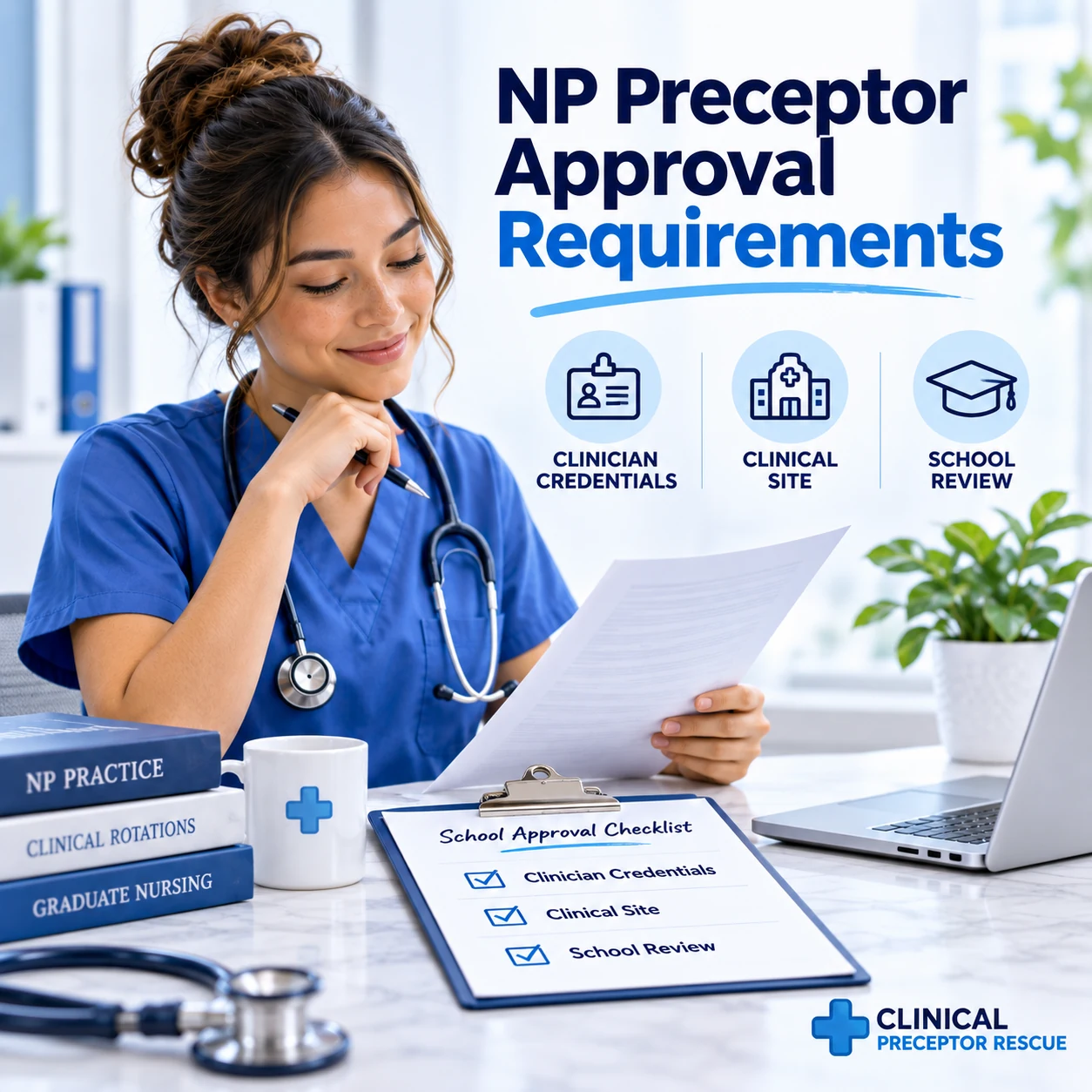
NP preceptor approval requirements vary by program, but schools may review a clinician’s professional license and qualifications, the fit with your course objectives, and whether the clinical site meets your rotation needs. They may also require preceptor forms, site agreements, or onboarding steps before you can begin. Start with your program’s current clinical handbook and course instructions rather than assuming that a willing clinician is automatically approved.
Finding a clinician who is happy to precept you is an important step. Yet preceptor approval, clinical-site approval, and authorization to begin your rotation can involve different reviews. Your school and the site, not a matching service, set their applicable requirements.
If you are managing coursework, family, and a deadline at the same time, this guide will help you understand what to check, who may handle each step, and what to ask before your proposed placement moves forward.
Quick Answer
In many NP programs, school approval can involve four areas: (1) the preceptor’s credentials and relevant experience, (2) the match between the clinical experience and your course objectives, (3) the clinical site and any required agreements, and (4) the program’s forms, review, and onboarding process. Requirements differ by school, course, site, and sometimes state. Confirm your program’s decision and your site’s clearance before beginning clinical hours.
In This Section
- Why Finding a Preceptor Is Not the Same as School Approval
- NP Preceptor Approval Requirements: What Schools May Review
- Preceptor Approval vs. Clinical Site Approval
- Who Handles Which Part of the Paperwork?
- Your NP Preceptor Approval Readiness Checklist
- Questions to Ask Your Program Before You Submit
- What Happens After You Submit a Preceptor for Approval?
- What If the Preceptor Is Willing but the Placement Is Not Approved?
- How Clinical Preceptor Rescue Can Help
- Frequently Asked Questions
- Ready to Move Forward With Your Preceptor Search?
- Resources
Why Finding a Preceptor Is Not the Same as School Approval
A clinician may be willing and available for your requested dates, but your program still needs to decide whether that person and setting can support the clinical learning experience your course requires. The American Association of Colleges of Nursing (AACN) explains that program faculty oversee the design and evaluation of clinical practice experiences and student outcomes.
For example, a family nurse practitioner student may need a setting that supports care across specific patient populations, while a psychiatric-mental health student may have different specialty expectations. A clinician can be experienced and enthusiastic yet still not meet a particular course’s eligibility criteria.
Think of the process as three distinct questions: Is the clinician willing and available? Do the preceptor and site meet the clinical course’s requirements? Has your program, and, where applicable, the clinical site, given the necessary authorization?
An informal yes from a clinician, a matching conversation, or preliminary paperwork is not final authorization. Ask your clinical coordinator how approval is communicated and whether you must receive written clearance before the first clinical day.
NP Preceptor Approval Requirements: What Schools May Review
The following are common areas of review, not a universal eligibility checklist. Saint Louis University, for example, describes a process involving a preceptor information form, license verification, course review, and possible clinical-agency agreements. Your university may handle the same decisions differently.
1. Professional credentials and relevant experience
A program may request the proposed preceptor’s professional license information, certification, current role, practice focus, clinical experience, or resume/CV. Your school decides which clinician types and credentials qualify for the specific course. Do not assume a professional title or an unrestricted license alone guarantees eligibility.
2. Fit with the rotation’s learning objectives
A school may examine whether the clinician’s actual patient-care work, practice setting, patient population, and scope of practice align with your course objectives. Specialty labels can be helpful, but they do not always tell the full story of the learning opportunities available.
3. Schedule, required hours, and supervision
A proposed arrangement should also be feasible for your required clinical hours, dates, and schedule. Depending on the program, the preceptor and faculty may need a plan for supervision, evaluations, communication, and documenting completed learning activities.
Preceptor Approval vs. Clinical Site Approval
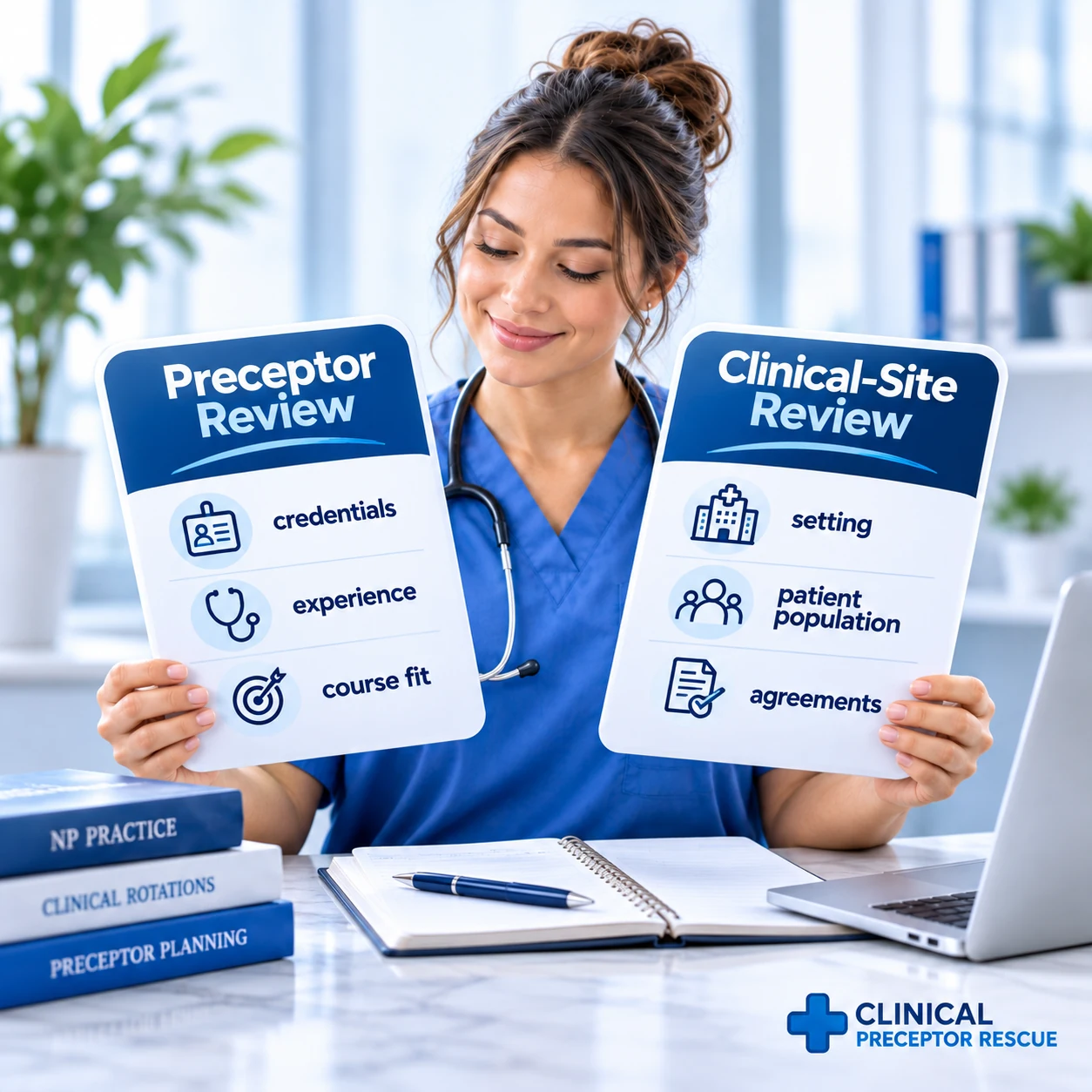
These are related but different reviews. Preceptor review focuses on whether the individual clinician is qualified and appropriate to teach this particular rotation. Clinical-site review focuses on whether the location and learning environment are acceptable for the course.
Preceptor review may include the clinician’s professional credentials, experience, role, and course fit. Site review may include the practice type, patient population, learning opportunities, onboarding, and whether an affiliation or other agreement must be in place.
The National Organization of Nurse Practitioner Faculties (NONPF) publishes sample preceptor and affiliation materials that illustrate how these may be documented; they are examples, not a universal packet every student must complete.
Responsibilities also differ between institutions. For example, Walden University says its field-experience office works on site affiliation agreements while students provide site administrator contact information.
Saint Louis University uses its own approval and facility-contract request process. Ask your school who is responsible for each task instead of assuming that you or the preceptor must negotiate an agreement.
Who Handles Which Part of the Paperwork?
Student: Confirm the current course requirements, deadlines, rotation details, and who to contact. Complete any student-assigned forms and share accurate information when requested.
Preceptor: If requested by the program, provide relevant credentials, experience details, availability, or signatures. The school determines what documentation it requires.
Clinical site: Confirm site-specific onboarding, clinical access, and whether an authorized administrator needs to participate in an affiliation or other agreement.
School or clinical program: Review academic fit, coordinate its approval procedures and required agreements, explain outstanding requirements, and communicate final authorization.
Your NP Preceptor Approval Readiness Checklist
Use this approval-focused checklist before submitting a proposed preceptor or site. You do not need to collect every item yourself: the purpose is to identify the requirements and who is responsible for each one.
Confirm which course, specialty, patient population, and learning objectives the placement must satisfy.
Confirm the rotation dates, clinical hours, and whether your proposed schedule satisfies the course.
Find the current preceptor/site submission deadline and required school review steps.
Ask which credentials, professional roles, and experience levels your school will accept for this rotation.
Clarify whether a preceptor CV, license verification, certification details, or school-specific form must be provided, and by whom.
Check whether the clinical site’s practice type and patient population meet the course’s requirements.
Ask if the site needs an affiliation agreement, contract review, or separate authorization, and which office handles it.
Confirm any school- or site-specific student onboarding, training, health clearance, or access steps.
Find out how final approval is communicated and whether written permission is needed before counting hours.
The program may request these items at different stages. Use the checklist to reduce avoidable back-and-forth, not as a claim that every school or Clinical Preceptor Rescue requires the same documents.
Questions to Ask Your Program Before You Submit
If you are unsure where to begin, contact your clinical coordinator or placement office with a short, focused set of questions:
What qualifications must my preceptor meet for this specific course?
Does my school review the preceptor and the clinical site separately?
Which forms or supporting documents are required, and who is responsible for submitting them?
Does the school need a formal agreement with the site before the rotation can begin?
What are the submission deadlines, and how will I know when approval is final?
If the school requests changes or declines the site, what is the proper next step?
Use your current clinical handbook, course portal, and announcements as the source of truth. Ask the clinical coordinator for clarification when requirements are unclear; policies may differ between universities and even between courses at the same school.
What Happens After You Submit a Preceptor for Approval?
Step 1: Your program reviews the information
The program may review the preceptor and clinical site against its current standards. Faculty, clinical placement personnel, and sometimes site administrators may each have a role; the school can explain who performs the final review.
Step 2: Someone may request clarification or documents
A program might ask for more details about clinical credentials, patient populations, dates, schedules, or the site. Keep your relevant contact details and program instructions organized so you can respond efficiently.
Step 3: School and site onboarding steps may follow
Once an arrangement moves forward, the school or site may require orientation, forms, training, or system access. Some requirements can also depend on the state where the rotation occurs. Follow your current program and clinical-site directions; there is no single national onboarding checklist.
Step 4: Confirm your authorization before starting
Confirm exactly how school approval and site clearance are communicated. Do not start or count clinical hours until your program and site authorize you to do so under their rules. There is no universal approval timeline.
What If the Preceptor Is Willing but the Placement Is Not Approved?
First, ask your program what specifically needs attention. Sometimes the issue is missing information or documentation; in other cases, the clinician or site may not meet the requirements of the rotation.
If more documentation can resolve the problem, ask which party must supply it and whether the deadline is workable. If the preceptor or site is not eligible, ask which course requirement is unmet and whether another acceptable arrangement is possible. Avoid assuming an appeal, exception, or substitute will be accepted.
If your original option is no longer suitable, you can review your requirements and explore other potential preceptors. The goal is to find an appropriate clinical learning experience that your program can actually approve, not simply the first available name.
How Clinical Preceptor Rescue Can Help
Clinical Preceptor Rescue supports NP students across the United States who are looking for potential clinical preceptors. Its published student process starts with the Student Interest Form; after sharing your information, you can schedule a quick call to discuss your clinical needs and rotation details.
When you reach out, share your specialty, preferred location, required hours, expected dates, and any school-specific preceptor or site criteria you already know. Those details can make the conversation more focused.
Matching support can help you explore preceptor options and coordinate the search, but your academic program decides whether a proposed clinician or site meets its academic requirements. A potential match does not guarantee approval, a particular location, or a completion timeline.
Frequently Asked Questions
For questions about working with Clinical Preceptor Rescue, see the preceptor matching FAQs.
Does finding an NP preceptor mean my school will approve the rotation?
Not necessarily. A clinician’s willingness is important, but your program may still need to review the preceptor’s qualifications, clinical setting, course fit, and required documentation.
What paperwork does a school usually need from a preceptor?
Some programs request a CV, professional license or certification details, a preceptor agreement, or school-specific forms. Others handle these details through the clinical office or site. Your program should give you the exact list and explain who submits each item.
Can my school approve the preceptor but not the clinical site?
That can happen when a program reviews the clinician and practice setting separately. Ask whether the concern relates to credentials, site suitability, learning objectives, agreements, or onboarding requirements.
How long does school approval take?
There is no standard timeline that applies to every NP program. Ask your school about its current review procedures, paperwork deadlines, and how final approval is communicated.
Can a preceptor matching service guarantee school approval?
No matching service can make your academic program’s approval decision. Clinical Preceptor Rescue can discuss potential matching support, while the school and clinical site retain their own requirements and authority.
Ready to Move Forward With Your Preceptor Search?
If you have confirmed your school’s preceptor qualifications, clinical hours, dates, and site requirements, you are better prepared to discuss a potential placement. Clinical Preceptor Rescue can help you explore preceptor options. When you are ready, complete the Student Interest Form and discuss your rotation details with the team. Your school and clinical site will still make their own approval decisions.
Plan your next steps with our guides on when to start looking for an NP preceptor and what to prepare before requesting a preceptor match.
Resources
Use your program’s current handbook as the authority for your own rotation. The following resources offer general professional guidance and named examples of how approval processes may work:
- American Association of Colleges of Nursing (AACN) — APRN Clinical Preceptor Guide
- AACN — Curriculum Guidelines and Standards for Quality Nurse Practitioner Education
- National Organization of Nurse Practitioner Faculties (NONPF) — Faculty & Preceptor Clinical Support Hub
- Saint Louis University — Instructions for Preceptor Approval Process
- Walden University — Nursing Practicum Approval Process
